In the third quarter we initiated a position in TPG. We see several tailwinds for alternative asset manager earnings over the next few years and believe that TPG is well positioned to benefit. The stock is currently trading at cycle low valuations with a robust opportunity set across their core competencies (private equity, institutional), and emerging growth segments (private credit, wealth, insurance). We believe TPG will benefit disproportionally from the tailwinds present in the industry as well as shifting market perception from a niche private equity specialist to an industry titan with exposures in all fundraising and product segments.
Sector tailwinds
We believe alternative asset managers represent a unique opportunity set over the next several years with discounted valuations, secular growth opportunities, and accelerating realizations.
We see tailwinds from continued growth in the private wealth channel and potential Department of Labor guidance on 401(k) inclusion. The longer duration of 401(k) assets is a natural fit for private equity, even more so than the existing wealth product suite. Because companies are staying private longer, a substantial amount of value creation now occurs outside of the public markets (e.g. OpenAI, Anthropic, Stripe, SpaceX). At the same time, the market’s focus on quarterly results has become an obstacle to longer-term investment in certain industries. These factors lead us to believe there is structural alpha in private assets, particularly when those assets are matched with an equally long duration investor base. We view continued wealth channel penetration and broader 401(k) inclusion as a significant opportunity for alternative asset managers, and we believe that opportunity has been obscured by recent concerns around private credit quality and redemptions in semi-liquid wealth vehicles.
We are also encouraged by public market valuations for software companies and other AI exposed industries. Withdrawals from semi-liquid private credit vehicles have continued to slow, and we believe will soon stop weighing on growth and valuations. Ultimately, we think it will benefit the industry to have experienced a redemption cycle as the channel develops. In our view it is healthy for participants to experience the liquidity limitations of private assets firsthand so they can calibrate the liquidity tradeoff for clients as the channel grows.
The M&A environment for sponsors has been relatively quiet for the last several years but with uncertainty emerging about the regulatory environment post 2028, and continued pressure from investors to return and recycle capital we believe the stage is set for an acceleration in both investments and realizations by alternative asset managers. Over the next several years alternative asset firms will monetize significant unrealized performance fees which will be an incremental earnings tailwind alongside continued management fee growth.
Platform Expansion
The market still prices TPG as an institutionally funded, private equity firm. This helps explain why it trades near the average of peers despite its fee related earnings (“FRE”) growth being best in class. Investors view an alternative asset manager’s product suite depth as an essential component when evaluating the quality of the business, and private credit has been one of the industry’s fastest growing segments. We do not view TPG as a monoline manager and think we are in the middle innings of this platform expansion. Currently, the company is over indexed to institutional capital (92% of assets), and under indexed to the insurance and wealth channels. TPG is a recent entrant in the credit space after acquiring Angelo Gordon in 2023, but they have doubled credit AUM since the acquisition.
We are optimistic about growth in the wealth channel for the industry and don’t believe this will be a winner takes all market. Given the high level of redemptions out of closed-end private credit funds in the wealth channel that took place early this year, we think advisors will reevaluate the alternative funds they are offering to clients. We think TPG will be a net beneficiary of that reshuffling. In other words, we think TPG provides a competitive alternative to some of the legacy offerings of their competitors.
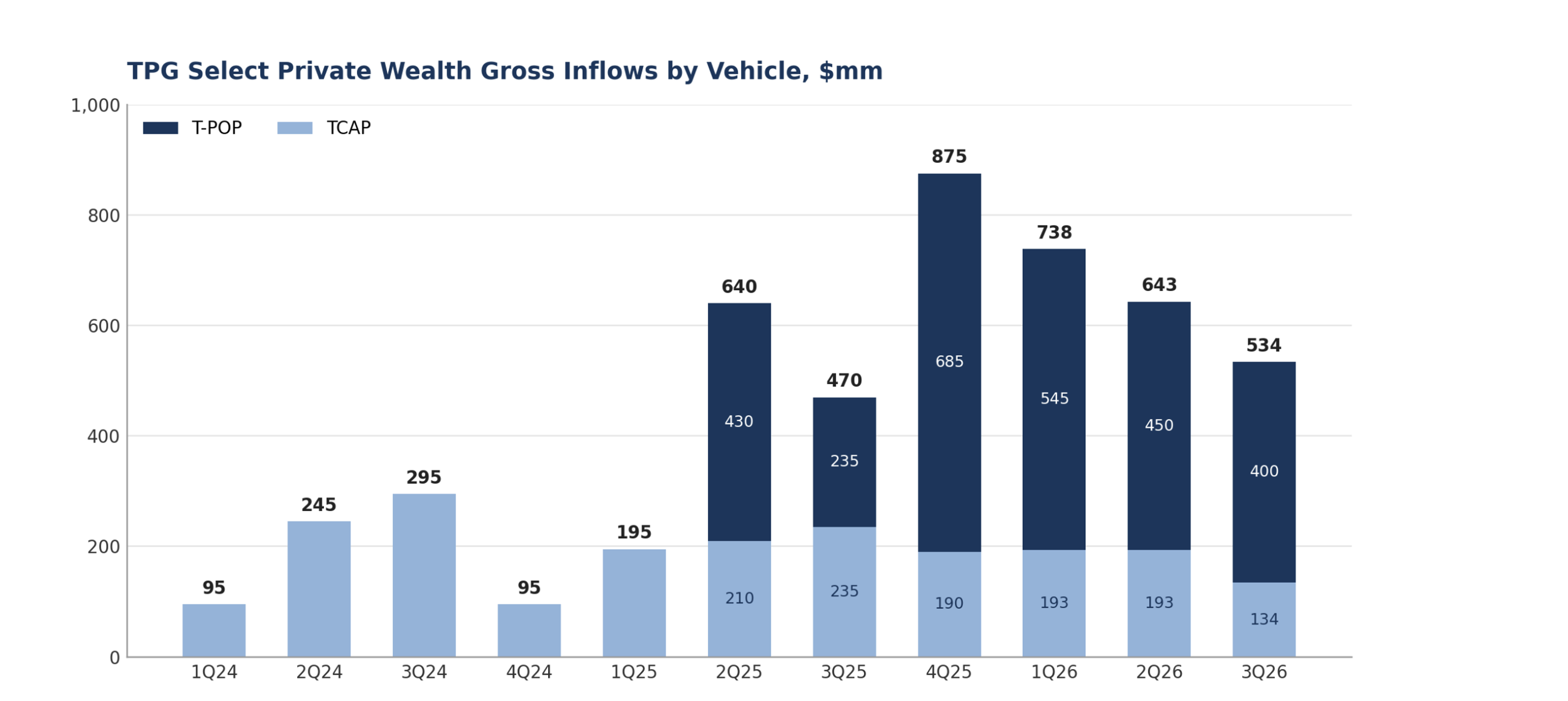
Source: Company commentary, Street estimates, and Gator estimates
Prior to the Angelo Gordon acquisition, the company’s AUM was nearly 80% private equity, today that percentage is closer to 50%. In 2025 TPGs credit business grew fee-paying AUM by 23%. Our view is that the monoline perception is outdated and TPG will continue to grow above industry levels in private credit.
Given TPG’s smaller base in the wealth channel and private credit, strong industry growth and modest share gains should drive outsized AUM and FRE growth over the next several years.
Flagship fundraising and performance strength
We have been impressed with TPGs track record of flagship fundraising, growing successive funds across their different verticals. Below are a few recent fundraising results we think demonstrate this thesis.
TPG X: $14B raised to date 15% above the predecessor fund
TPG Rise Climate II: Fund raised $8.5B +16% vs predecessor with full program raising $11.4B
TREP V: First close already at $5B vs predecessor at $7B
Credit Solutions III: Raised $6B and was nearly 2x predecessor fund
TPG expects to double credit AUM to $200B by the end of 2029, and they have targeted $55B in total fundraising this year.
As they discussed on their most recent earnings call, TPG’s asset flows are becoming less dependent on lumpy flagship fundraising vehicles. We believe a consistent fundraising engine across cycles is a driver of premium multiples for some of their peers.
We view performance as perhaps the most important leading indicator of further demand. TPG funds have performed well versus competitors specifically in their core private equity funds, consistently generating mid-teens IRRs. Strong private credit performance is notable, and this supports our view that they will continue to take market share.
FRE growth and margin opportunity
Analysts expect TPG to grow assets under management in the high teens over the next couple of years. While impressive we view this growth as quite conservative given the tailwinds detailed above.
Coupled with the compelling growth opportunity of the top line, TPG is targeting significant FRE margin expansion over the next few years. TPG is targeting 48% FRE margin for 2026, up from 45% in 2025, and we believe margins of 50% are achievable by 2027. Margins may keep expanding from there as they continue growing assets on a relatively fixed cost base.
We think asset managers generally will realize margin benefits from AI initiatives. Leveraging AI to do deeper diligence on companies at a faster rate should boost margins over time.
Incentive realizations and investment acumen
TPG’s earnings are poised to benefit from unrealized carry within its funds. We believe that the next few years could represent a large realization period for all alternative asset managers. TPG specifically has about 7% of market cap sitting in unrealized carry which is equivalent to 1.3x FY25 after tax distributable earnings. TPG realized $205M in carry in FY25, monetizing the current balance over the next three years would roughly double that pace.
Post 2021, there has been a slowdown in private equity monetization activities. With the recent move in yields and geopolitical volatility, there is a concern that this M&A logjam will persist longer. In 2021 TPG’s PE business had realizations reach almost 30% of total AUM vs peers in the high teens to low 20s. In the trough years of 2024–25, TPG still realized 10% of total AUM and 9% of its private equity AUM annually, in line with peers. We like TPG's earnings upside in a robust sponsor M&A market, but we are comfortable with their ability to continue to monetize assets even if tougher conditions persist.
One of the drivers of the selloff in alternative asset managers early this year was the perception that managers had invested heavily in software businesses that would be negatively impacted by AI. TPG was particularly targeted by this narrative as they are known as technology specialists and have 11% of their assets in software. We view software and other AI-affected industries as rapidly changing and we anticipate a wide divergence in outcomes across these industries. We believe TPG’s expertise in software leaves them better positioned than peers to navigate this environment.
Discounted valuation
The alternative asset manager sector represents a compelling buying opportunity with many peers trading at 20%+ discounts to 5-year multiples, with significant forward earnings growth still expected. Most of the group currently trades under a 1x PEG ratio.
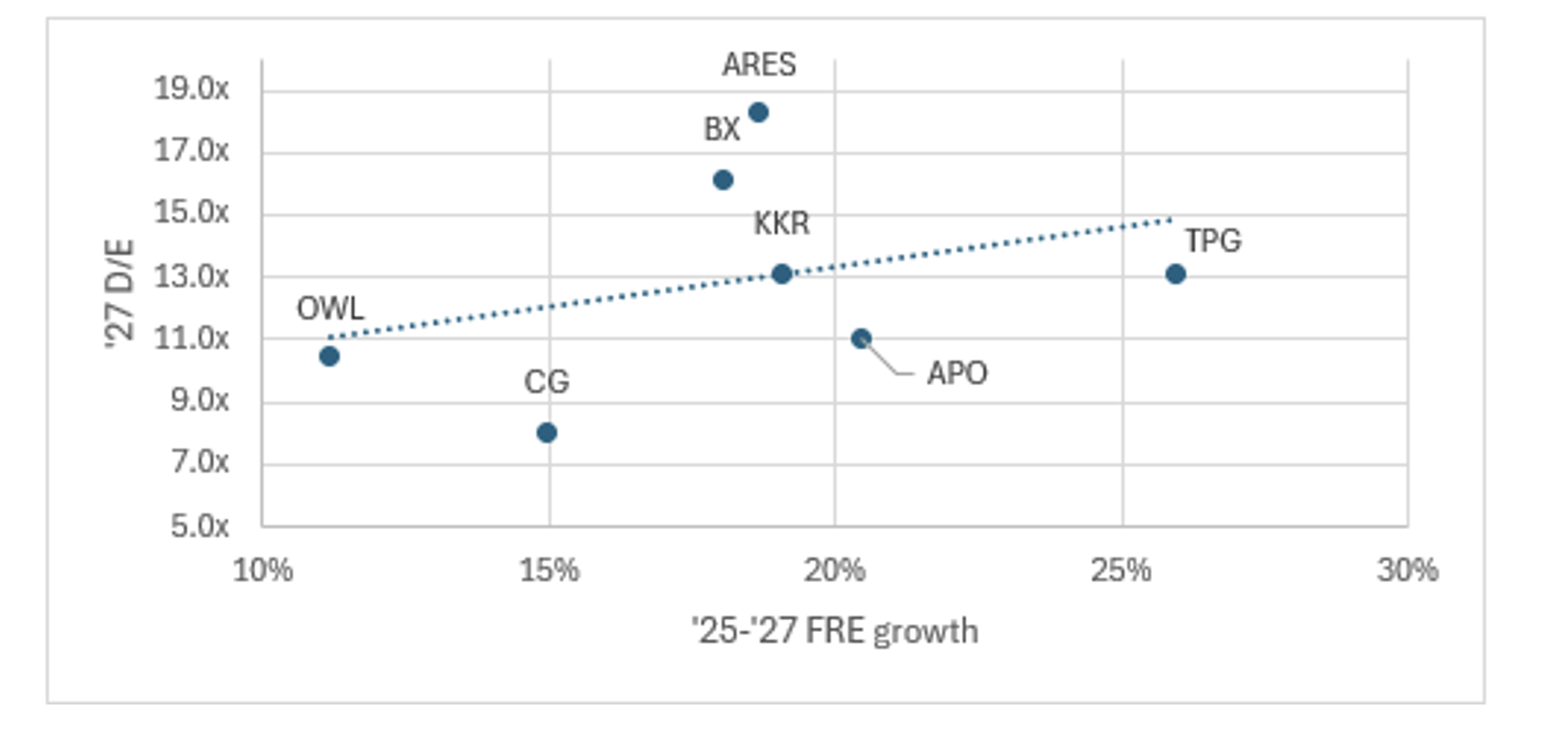
TPG specifically is trading at a 20% discount to its average next twelve months of distributable earnings (“DE”) multiple which has averaged 18x since its IPO. Shares are down 27% YTD with '27 EPS estimates only down 4%. TPG offers the fastest FRE growth profile among peers and trades around the median multiple.
Risks
Here are the risks we see to our TPG investment thesis:
Stock-based compensation and dilution - TPG excludes equity-based compensation from its reported fee-related earnings (FRE) and distributable earnings (DE). Some of that expense is acquisition-related and should fade, but recurring equity awards are a real cost to shareholders. If the diluted share count continues to rise, strong growth in firmwide earnings may translate into more modest growth in earnings per share. We therefore pay particular attention to per-share earnings growth.
A slower recovery in sponsor M&A - Higher long-term rates make acquisitions harder to finance and can widen the gap between what buyers are willing to pay and what sellers are willing to accept. If exits take longer than we expect, TPG will realize less carried interest in the near term and return less cash to limited partners. That can also slow fundraising for successor funds as investors wait for distributions before making new commitments.
Renewed redemptions in private credit wealth products - Redemption requests have moderated, but weaker credit performance or renewed concerns about liquidity could prompt another wave. Limits on quarterly repurchases can slow outflows, but persistent requests could discourage advisors from directing new money to these products. That would make it harder for TPG to grow its wealth business, even if its own funds perform well.
Slower insurance allocations to private credit - Insurers are an important source of long-duration capital for alternative managers. If tighter capital requirements, less attractive yields relative to public bonds, or greater scrutiny of illiquid assets cause insurers to slow new allocations, industry assets under management could grow more slowly. For TPG, fewer new mandates or slower deployment would delay growth in fee-earning assets and FRE. Jackson Financial’s $12 billion minimum commitment provides a base, but growth beyond that commitment and across other insurers remains less certain.
AI disruption in software - TPG disclosed that software accounted for 11% of firmwide AUM, with most of that exposure in private equity. If AI weakens pricing power or customer retention at portfolio companies, earnings and exit multiples could fall together. TPG’s software expertise may help it distinguish durable businesses from vulnerable ones, but losses in a few large investments could still reduce carried interest, weaken fund returns, and make the next fundraising cycle harder.
Disclaimer: The discussion of any security is meant solely as an illustration of our investment and thought process and should NOT be considered as a recommendation or suggestion to buy or sell any securities. Before you make any investment, do your own research and talk to your own financial adviser. Information in this report is received from external sources. Therefore, we can make no guarantee as to the completeness or accuracy of the information provided.
Not all research is for securities currently held. Any securities for which research is provided herein may be reduced, completely closed out, or not purchased at all without notice of any kind.